
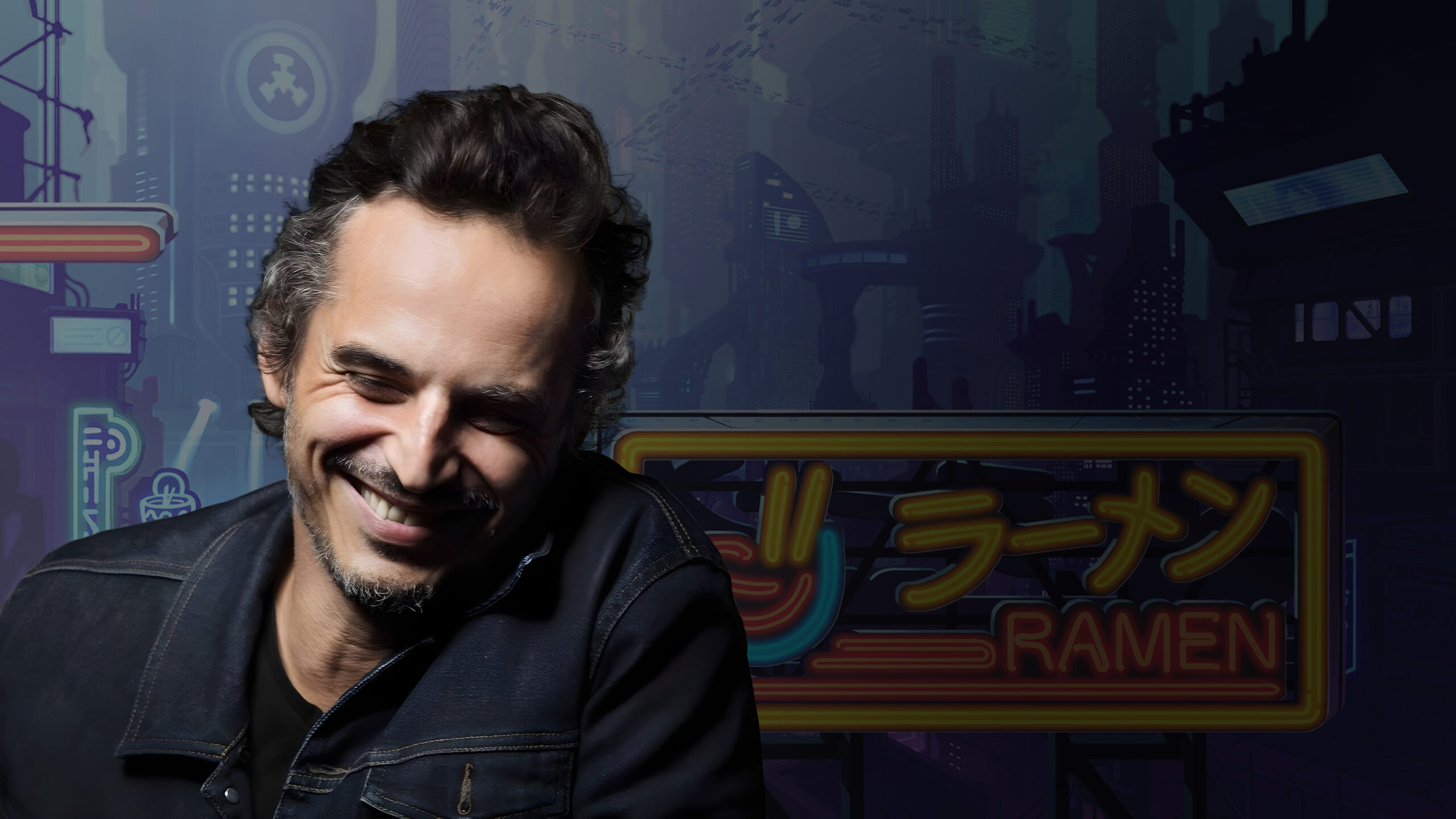

We’re proud to join forces with the designer behind Manuel Rozoy. This collaboration has been a long time in the making. We’ve always wanted to collaborate with someone who brings not only deep experience in game design, but also a true mastery of adaptation. Manuel has worked on major licenses, crafted elegant systems, and consistently delivered games that strike a balance between clarity, tension, and narrative precision.
Partnering with Ubisoft on this project set a high bar, and we needed someone whose passion, discipline, and creative rigor could match that level of excellence. Manuel was the perfect fit. His understanding of what makes Brawlhalla unique (rhythm, energy, accessible depth) made him the ideal person to bring this universe to the tabletop.
We’re thrilled to share a short interview with him, offering a closer look at his vision, his process, and the spark behind this new adaptation. Enjoy the read, and welcome to the arena.
QUESTION 1
How did you approach adapting Brawlhalla into a card game? What were, in your opinion, the priorities to preserve the spirit of the original game?
I started with a very simple question: when you put the controller down, what remains of a Brawlhalla session? For me, three things.
First, before any technical or theoretical consideration, it’s the sensations: you feel a freedom of movement that quickly becomes constrained by the opponent’s pressure. The priority was to capture this as faithfully as possible: a modular arena, with platforms and off-stage zones, allowing positional play between Legends depending on the arena layout.
Next, Brawlhalla’s gameplay sensations are deeply tied to the game’s accessibility. You can have fun with friends just for a casual match, but you can also play in a very technical way. It may sound like a cliché, but Brawlhalla is the best example of the famous “easy to learn, hard to master.” The goal was to translate that as well as possible into the adaptation: if you want to play for fun, you choose a deck, the game is explained in five minutes flat, and you play using only your Legend’s ability and your weapon. And if you want a slightly more technical game, you add the power cards unique to each Legend, which add an extra layer of combinatorics and depth.
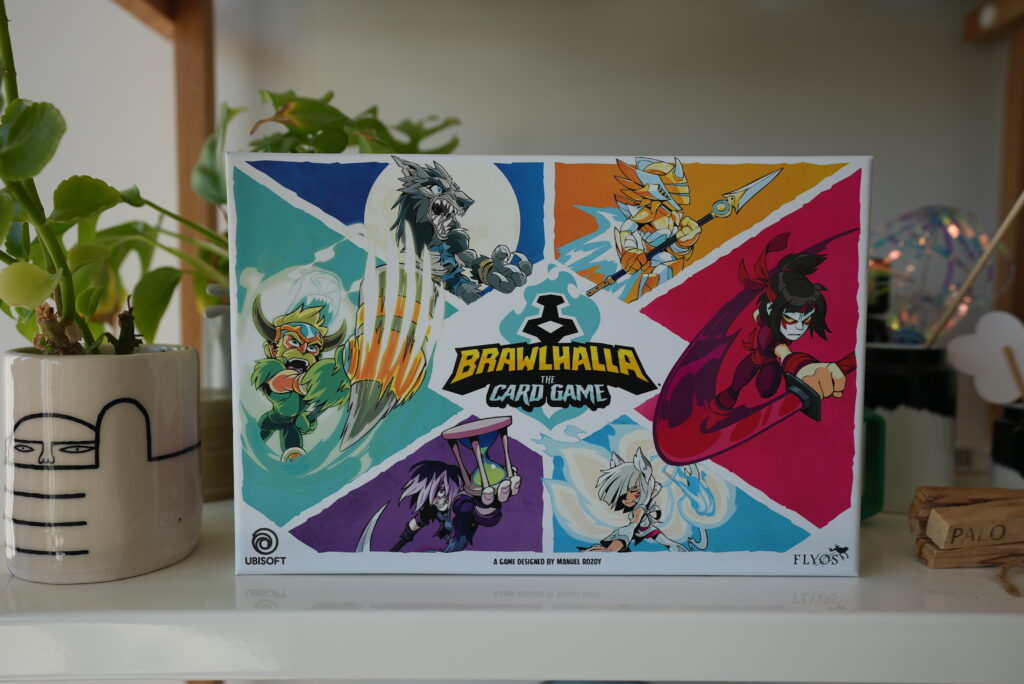
And finally, there’s the originality of light attacks and heavy attacks, which absolutely had to be included! In Brawlhalla: The Card Game, light attacks allow you to weaken your opponent, but only a heavy attack can knock them out of the arena. This creates tension before every strike, as you try to anticipate—based on each Legend and their weapon—what attack to use to achieve your goal.
QUESTION 2
Brawlhalla’s fast pace and intensity are essential. How did you translate them into card-game mechanics?
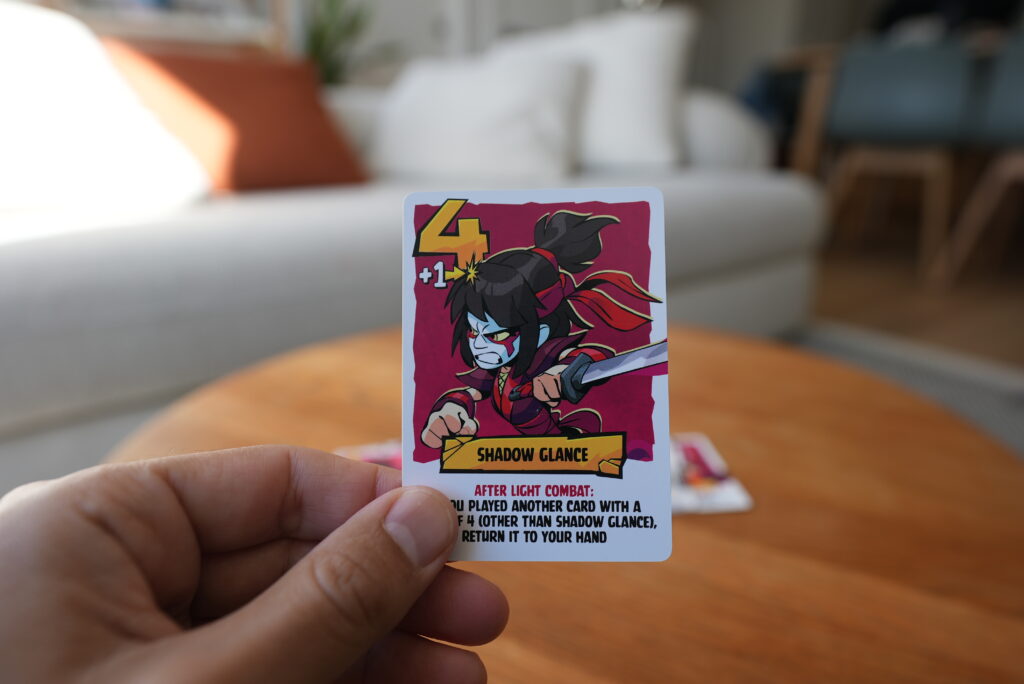
The turns are compressed to the maximum: two actions out of three available. You move, you strike, or you recover… and then it’s already the next Legend’s turn. Every decision revolves around the same small set of cards: the value of the card you spend to move, defend, or attack only exists in four copies within your 20-card deck. That’s how you identify what your opponent has already played and when to land a heavy attack at the right moment.
Beyond their individual effects, the cards are the game’s true resource: you must weigh your choices carefully to maintain a hand advantage, which remains one of the keys to victory. This strengthens the game’s dynamic nature and creates a very tight, fast rhythm.
QUESTION 3
As a designer, what was the biggest challenge in balancing accessibility, immediate fun, and strategic depth?
The real challenge was resisting the temptation to include everything. Brawlhalla is a vibrant and technical game: if you try to translate everything into keywords and adapt all the video game mechanics, you lose immediacy and accessibility.
For example, during the design phase, I spent a lot of time thinking about Signatures (Sig) — neutral, side, up, or down. As a mechanic, it’s great: an attack produces different effects depending on the angle. But in a card game, it adds a layer of complexity and a set of exceptions that break the flow.
The goal was to preserve what makes up Brawlhalla’s DNA without overloading the gameplay on a different medium.
QUESTION 4
You’ve worked on very narrative-driven games like Time Stories. What did that experience teach you, and how did it influence your approach to a competitive action game?
Time Stories taught me two fundamental things: rhythm and the readability of information. Even in a competitive action game, you’re telling the players something: who is in danger, who has the initiative, who “reads” the other better.
So I approached a duel like a little scene: a rising tension, a turning point, a clear consequence. Action management comes from that too: in Time Stories, every action matters. In Brawlhalla: The Card Game, every card you spend is both a narrative and mechanical choice. You can absolutely tell the story of the match afterwards.
QUESTION 5
What fascinates you the most in the Brawlhalla universe? A character, a tone, an energy?
What I love most is that constant contrast between the seriousness of combat and the completely uninhibited, over-the-top tone of the universe. You’ve got a Viking, a ninja, a space knight, and a werewolf all knocking each other around above a cosmic void — and everyone just accepts it as normal.
I love Hattori for her finesse and speed! Fast & Furious, but with delicacy.
QUESTION 6
In your opinion, what makes a successful adaptation of a well-known license?
I had already worked on adaptations — on Rabbids while I was at Ubisoft, on Assassin’s Creed, or on L’Incal, a very famous comic book in Europe. That experience obviously helped.
In fact, a good adaptation isn’t about reproducing everything; it aims to translate a feeling. If you try to recreate the video game identically on the table, you’ll inevitably disappoint. You need to identify the heart of the experience and accept that you must sacrifice the rest.
Another key point is respecting what fans who know the game expect: they need to recognize their Legends and feel something close to what they experience in the video game. This respect comes through strong game-design choices. My training comes from theater: I’ve staged classical and contemporary authors, and each time, the question when putting a text on stage is the same: how do you best convey what the writer intended the audience to feel? It’s the same work when adapting a video game.
QUESTION 7
Can you describe your creative process? Where does the first spark come from when you design a game system?
Generally, I start from a precise moment I want players to experience. For Brawlhalla, it was that micro-moment when you tell yourself: “If I touch them, they’re out.”
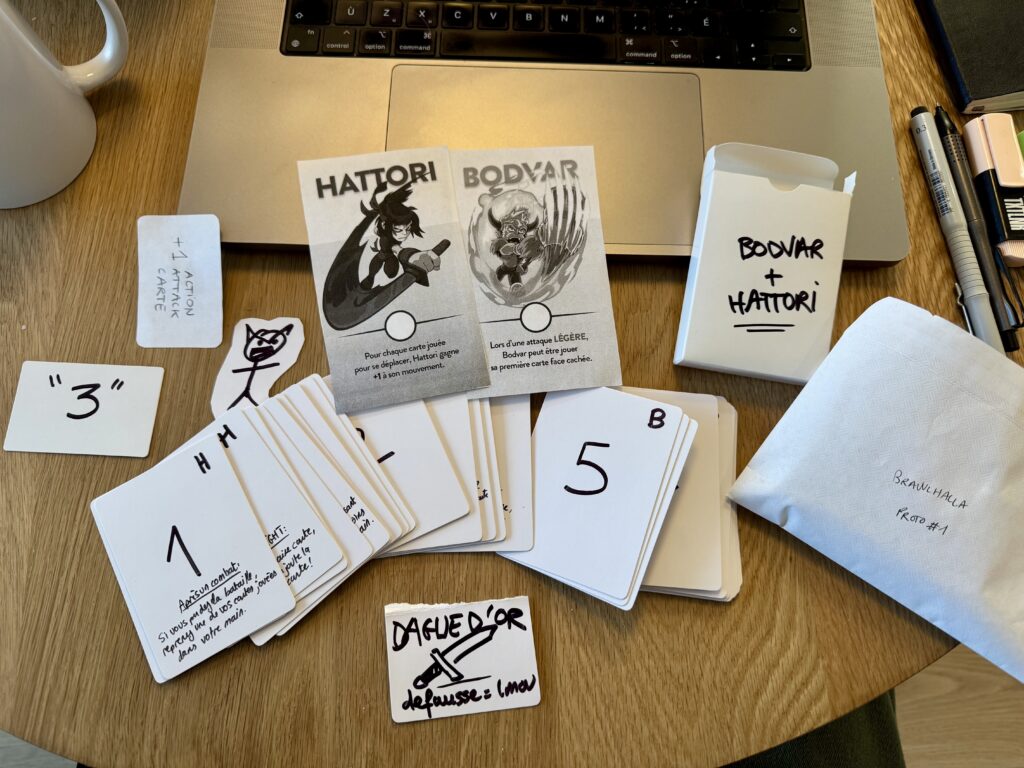
From there, I look for the simplest possible system that can generate that moment again and again. But simplicity is complicated… and it takes time. Then comes the work phase. I prototype a lot, with just numbers and a few powers, then I push the system with extreme questions like: “What if it’s a camping match?” “What if everyone plays at the edge of the map?” “What if both players meet at the center at the same time?”
When the system survives that, you can start entering the polish phase: balancing Legend powers (we’re still doing that), stress-testing the flow (which takes a ton of time), refining the arena, the rhythm, etc.
QUESTION 8
How did the collaboration with FLYOS go on this project?
Very simply: I was given complete freedom on the system, and they never blocked me.
Every meeting served to reintegrate a mechanic or refine a concept. FLYOS arrived with real adaptation experience — after licenses like Vampire or Rayman — and that changes everything: you immediately sense that your counterpart, thanks to feedback from Ubisoft’s designers, knows exactly what is “sacred” for fans and what can be transformed.
They also pushed hard for clarity of rules, readability of the board, and making sure the arena “tells the story” of what’s happening without requiring three pages of explanations. We refined token sizes, KO mechanics, off-stage behavior… until we found a satisfying core system that works in 1v1, 2v2, or even free-for-all.
QUESTION 9
If you had to summarize Brawlhalla: The Card Game in three words, which would you choose?
Nervous, explosive, tactical.
QUESTION 10
Finally, what would you like players to feel after their first matches?
Ideally, I’d love for them to look at each other across the table and say: “Let’s play again.”
That they feel like replaying the same Legend to master their abilities, or switching decks to try a new style. And above all, that they feel like they’ve played Brawlhalla — without the screen, but with the same sensations!
Brawlhalla: The Card Game campaign is now live on Kickstarter!
If you’re a fan of tactical games, if you’ve followed Manuel Rozoy’s work, or if you simply want to experience his unmistakable design touch in a brand-new project, this is the perfect moment to join us. Support the game, explore the first reveals, and be among the very first to step into the arena.
No Comments.