Talking Limbs and Legends: An Interview with Maxime Tardif
Today, we sit down with Maxime Tardif, the co-designer of Rayman: The Board Game.
Maxime Tardif is an award-winning board game designer best known for EARTH and its recent expansion ABUNDANCE. With a keen eye for innovative mechanics and thematic immersion, his work has been recognized for its originality and engaging gameplay. A rising talent in the tabletop scene, Maxime brings his expertise and passion to every project he touches, including Rayman The Board Game, where he was entrusted with transforming a beloved video game universe into a fast-paced, accessible, and highly replayable board game experience. (This interview with Maxime Tardif has been translated from French.)
QUESTION 1
Maxime, to start, can you tell us how you got involved with the Rayman The Board Game project, and what motivated you to join?
I got involved in the project when Gary from FLYOS reached out to me about it. As a kid, I played a lot of Rayman, so I jumped at the opportunity to work on a board game based on a franchise I grew up playing during my childhood and teenage years! Gary and Thomas had already developed some early concepts and a framework for the game. For me, it was also a great opportunity to work on a team project and to create within specific constraints, two things I hadn’t done before.
A year ago, Maxime gave an overview presentation on Rayman and his role in its development (in French with subtitles).
QUESTION 2
Rayman is a cult classic in the video game world. In your opinion, what were the most important aspects of the universe to preserve in its adaptation to a board game?
I think one of Rayman’s biggest strengths is the fast-paced gameplay and the platforming feel. So my goal in designing the game was to keep things moving quickly, with minimal downtime, and to replicate the sensation of completing a level efficiently. The universe and theme are also very strong in Rayman, so it was important to design mechanics that would support and preserve those elements.
QUESTION 3
On the flip side, what elements of the video game were the hardest to translate into a board game, and how did you find solutions?
The most difficult aspect to retain was definitely the fact that Rayman is traditionally a solo platforming experience. We didn’t want to make a board game that was solo-only. So we had to adapt the mechanics to make it work well in a multiplayer setting. The solution we found to keep the pace fast and maintain a similar feel to the video game was to develop Rayman as a racing game, where players compete to complete the level as quickly as possible.
QUESTION 4
There are many racing games on the market. What, in your view, makes Rayman The Board Game different and unique compared to others in the genre?
First of all, there’s no other board game set in the Rayman universe, so the theme alone makes it stand out. Traditional racing games typically take place on a linear track, but Rayman unfolds on a level map with multiple layers. You can move up and down as well as forward. There are also enemies in the level that you can defeat to gain benefits. Part of the game is played simultaneously, which reduces downtime. The game features an initiative system that operates similarly to rock-paper-scissors. You have to try to anticipate what other players will do in order to optimize your own turn. So there are quite a few elements that differentiate it from other available games.
QUESTION 5
Can you walk us through your creative process for designing the racing and platforming mechanics in a board game format?
To get started, I played a lot of racing board games to get a sense of what already exists on the market—what works well and what doesn’t. That helped generate ideas and inspiration. I then imagined adding an initiative system to the racing mechanic to determine who acts first or last each round. It creates a nice balance of interaction and strategy, while allowing simultaneous play during the card selection phase. I also wanted to keep the game quick and straightforward, hence the two-card combo mechanic, where players select and combine only two cards per turn.
QUESTION 6
What design choices did you make to ensure the game remains accessible to families, while still offering enough depth for more experienced players?
That was indeed a key priority, since Rayman is a very accessible video game. Limiting turns to selecting just two cards greatly simplifies the gameplay. However, because each card is unique, experienced players can optimize their turns more effectively by choosing the best combinations and predicting their opponents’ initiatives. Multiple difficulty levels can be easily swapped based on the group’s experience. You can play a very simple or more complex version, depending on your needs. The game is intentionally highly modular.
QUESTION 7
Is there a particular mechanic or design element you’re especially proud of that you feel captures the essence of Rayman?
I don’t think there’s one single element I’m most proud of—it’s more the way all the mechanics come together to create a unique experience. I think what best captures Rayman’s DNA is the collection of small details that make the game feel true to the video game: projectiles, card effects, the way movement works, different level layouts, enemies and bosses, multiple difficulty levels, the rhythm, the visuals, and more.
QUESTION 8
How did the collaboration go with the art team to ensure the visuals and components captured Rayman’s colorful, energetic world?
I have to say, working with the FLYOS team was a great experience. They’re incredibly professional and worked very quickly to develop the visuals: levels, figures, cards, projectiles, bosses, and so on. I was actually very impressed by their speed and efficiency! Whenever I had a question, communication was smooth and responsive. It was a really enjoyable experience with strong two-way collaboration.
QUESTION 9
During playtesting, was there a specific moment or piece of feedback that really stuck with you and influenced the final design?
There were several moments when playtesters had a strong impact on the game’s development. The most important one was when, during a session, we realized that to speed up the game’s rhythm, we needed to introduce a simultaneous play phase. Adding that phase—along with the initiative system—really transformed the experience, and it was the most positive change to emerge from testing.
QUESTION 10
If you had to give one piece of advice to a designer adapting a major license into a board game, what would it be?
To have as much fun as possible during development. It’s a real privilege to work on a board game adaptation of a video game, so make the most of it—while working hard to make sure the final product truly reflects the feel and essence of the original game.
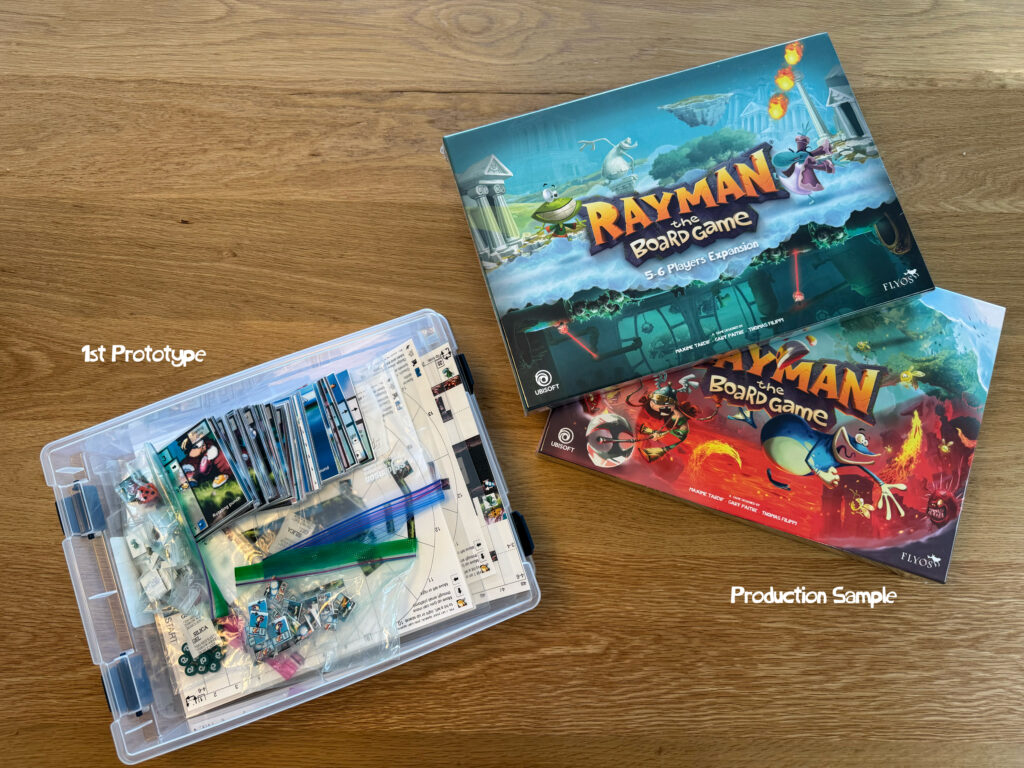
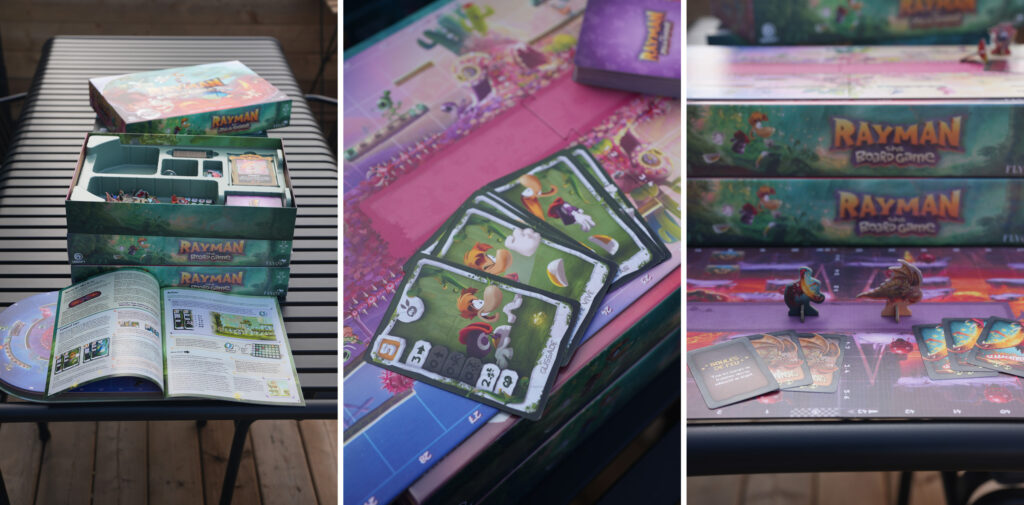
We hope you enjoyed this new interview! We understand how eagerly you’ve been waiting for updates on Rayman: The Board Game, and we’re happy to report that development is progressing well. FLYOS, together with LongPack, has just entered the molding phase, bringing us one step closer to mass production. Thank you for your continued support and enthusiasm! Please take a look at our latest update to know more.
As always, feel free to share your thoughts, questions, or feedback in the comments below!
Hello, FlyOS. When will there be news on Vampire The Masquerade? Each time the news comes out later and later. Soon the news release will be shifted by a month.
Hello Nomad,
Yes, we’re running a bit late. This new incoming update is a big one, with lots of pictures, a new rulebook for RETALIATION, and plenty to share. So we decided to push its release to this Wednesday.


Yes, we’re running a bit late. This new incoming update is a big one, with lots of pictures, a new rulebook for RETALIATION, and plenty to share. So we decided to push its release to this Wednesday.