

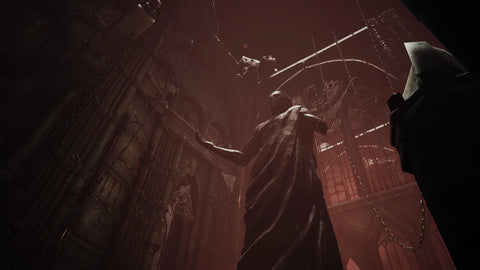
Bonjour à toutes et à tous, je m’appelle Gary, cofondateur de FLYOS et directeur créatif de Eternal Whispers. Pour notre tout premier journal de développement, j’aimerais explorer l’un des aspects les plus importants et déterminants du projet : son identité visuelle.
Comment dépeindre Montréal dans l’univers de Vampire: The Masquerade sans simplement recréer la ville rue par rue ? Comment transformer un héritage artistique né d’un jeu de plateau en un monde numérique cohérent ? Comment créer des environnements nocturnes stylisés qui restent lisibles et suffisamment riches pour soutenir l’exploration, la narration et les choix des joueurs ?
Je souhaite également vous montrer le jeu tel qu’il est réellement en cours de création. Certaines scènes sont déjà proches de notre vision finale. D’autres sont encore en cours de composition, d’éclairage, de texturage ou de décoration.
Dans ce journal de développement, nous reviendrons sur les origines de notre langage visuel, les références qui l’ont façonné et les étapes nécessaires pour le concrétiser.
1. Une identité née avec Vampire: The Masquerade – CHAPTERS
Les origines artistiques d’Eternal Whispers sont antérieures au jeu vidéo lui-même.
En 2019, nous avons commencé à travailler sur Vampire: The Masquerade – CHAPTERS, un jeu de plateau narratif financé en 2020 et sorti pour la première fois en 2022 avec une nouvelle édition définitive sur le point d’être lancée en quatre langues. CHAPTERS est une aventure de jeu de rôle sur table axée sur l’histoire dans une boîte, où les joueurs explorent divers lieux, font des choix significatifs, interagissent avec des personnages et font face aux conséquences de leurs décisions à travers plus de 60 scénarios.

Dès ses premiers stades, CHAPTERS a exploré Montréal à la fin de la période où la ville était sous le contrôle du Sabbat. Nous voulions construire des environnements cohérents, saisissants et suffisamment riches pour transmettre le poids de cet héritage, tout en accordant la même attention aux personnages qui les habitaient. L’adaptation de figures établies et la conception de nouveaux protagonistes qui pouvaient se tenir naturellement à leurs côtés ont joué un rôle majeur dans la formation de l’identité visuelle du projet. Nous nous sommes considérablement inspirés du livre source Montréal by Night, qui a introduit plusieurs des personnages qui apparaissent dans notre histoire.

Pour ce faire, nous avons collaboré avec plusieurs artistes remarquables, dont Dominik Mayer (Magic: The Gathering), Marc Simonetti (Game of Thrones, Dune) et Sergey Vasnev (Sony, Warhammer). Leur travail a contribué à établir la forte identité visuelle de Montréal dans CHAPTERS. Certaines de ces illustrations ont également trouvé une nouvelle vie dans Eternal Whispers.

Le Key Art d’Eternal Whispers a été créé par Bastien Lecouffe-Deharme, un artiste avec qui je rêvais de travailler depuis longtemps. Son travail joue un rôle essentiel dans la première impression du jeu et la promesse de son univers. Voici quelques croquis de nos premiers essais.

Cependant, l’arrivée de CHAPTERS dans le monde du jeu vidéo n’a jamais eu pour but de recréer le jeu de plateau exactement. Les jeux vidéo ont leur propre langage, leur rythme et leurs codes. Bien que les deux projets partagent une origine commune et une base artistique, leurs chemins narratifs et visuels divergent souvent — parfois beaucoup. Les joueurs familiers avec CHAPTERS reconnaîtront certains éléments, mais Eternal Whispers est finalement une expérience distincte. De même, ceux qui découvriront le jeu vidéo en premier trouveront quelque chose de nouveau dans CHAPTERS : une expérience unique de RPG en boîte.
2. Traduire un monde physique dans un espace numérique
Un jeu de plateau est nécessairement organisé autour de composants physiques et d’espaces clairement définis. Un jeu vidéo nous permet de construire des environnements plus grands, plus verticaux et plus immersifs. Nous avons néanmoins voulu préserver quelque chose du format « bouchées » de CHAPTERS : des blocs narratifs concentrés, chacun construit autour d’une mission avec sa propre identité, sa progression et ses opportunités d’exploration.
La structure d’Eternal Whispers est donc basée sur une alternance entre deux types d’espaces :
-
Le Havre, où le joueur se prépare, enquête, développe des relations et apprend les défis à venir ;
-
Les missions, conçues comme des chapitres narratifs autonomes d’une durée d’environ une à deux heures, selon les décisions du joueur et son niveau d’exploration.
Chaque mission rapproche les joueurs de la découverte des mystères centraux du jeu, de la compréhension de son paysage politique changeant et de la formation du parcours personnel de leur personnage.

Notre protagoniste, Gabe, n’est pas un ancien vampire. Ils ont été Étreints, empalés à travers le cœur et enterrés la nuit même de leur création, lors de l’infâme événement connu sous le nom de Nuit des Cendres. Lorsque vous vous réveillez vingt ans plus tard, vous êtes toujours un jeune vampire, mais un jeune vampire né d’un monde qui a depuis disparu : le Sabbat.
Cette prémisse façonne à la fois la narration du jeu et sa direction artistique. Le protagoniste découvre Montréal tout en redécouvrant son propre héritage.
3. Le Havre de Sam : un lieu qui évolue avec le joueur
Entre les missions, les joueurs retournent au Havre de Sam.
Sam est une Sans-Sang qui vit sous une petite librairie de quartier vendant des livres un peu désuets. Le magasin n’attire pas les foules, mais il fait partie du paysage local. C’est le genre d’endroit dont les habitants sont fiers d’avoir dans leur quartier, même s’ils ne le visitent pas souvent. Cette présence discrète offre à Sam une façade crédible tout en la protégeant des attentions indésirables.

Pendant la journée, Jade, la complice de Sam, tient la librairie et l’aide à protéger son secret — bien que Jade ait son propre agenda, que vous pourrez découvrir au cours du jeu. Une fois le magasin fermé, Sam est libre de poursuivre ses activités nocturnes avec vous à ses côtés. Au début, cependant, vous êtes plus un fardeau qu’un partenaire. Vous êtes le nouveau Kindred en ville, placé sous sa surveillance par ordre du Sheriff.

En tant que Sans-Sang, sa sécurité et son statut au sein de la société vampirique restent précaires. Cependant, elle a acquis un certain degré de respectabilité grâce aux concoctions qu’elle crée en utilisant l’Alchimie des Sans-Sang.
Le Havre a été conçu pour être bien plus qu’un menu entre les missions. C’est un environnement narratif à part entière, où les joueurs pourront :
-
obtenir des concoctions d’Alchimie de Sam ;
-
obtenir de l’équipement et des ressources ;
-
examiner le tableau des preuves résumant les événements précédents ;
-
découvrir des indices sur la prochaine mission ;
-
dépenser des points d’expérience pour améliorer votre personnage ;
-
renforcer ou endommager leur relation avec Sam (ou Toy) ;
-
résoudre des événements vampiriques quotidiens qui ne sont pas directement liés à l’intrigue principale.
Les joueurs peuvent se rapprocher de Sam et développer une relation plus intime avec elle, mais ils peuvent aussi saboter cette relation. Le Havre doit donc communiquer visuellement l’évolution de ce lien et les conséquences des décisions prises pendant les missions.
4. Un Montréal reconnaissable mais réinventé
Eternal Whispers n’a pas pour but d’être une reconstitution historique ou géographique de Montréal. Plutôt que d’explorer un monde ouvert rue par rue, les joueurs découvriront une vision soigneusement organisée de la ville, façonnée pour servir l’histoire et l’atmosphère du jeu.
Néanmoins, nous voulons que Montréal soit immédiatement reconnaissable par son identité. Cela inclut des points de repère tels que l’enseigne Farine Five Roses et la Croix du Mont-Royal, mais aussi des éléments plus quotidiens : ses quartiers, ses sous-sols, ses petites entreprises, son architecture, ses chantiers de construction perpétuels et, naturellement, ses cônes de signalisation orange emblématiques.

Nous stylisons la ville pour répondre à trois besoins fondamentaux :
-
soutenir la narration ;
-
créer des compositions visuelles puissantes ;
-
concevoir des espaces attrayants à parcourir et à explorer.
Les environnements doivent permettre de multiples approches. Certaines missions incluent des itinéraires secondaires, des passages latéraux, des espaces souterrains ou des systèmes d’égouts. L’identité visuelle d’un lieu doit rester forte sans nuire à la lisibilité spatiale ou à la liberté du joueur.

L’histoire se déroule sur environ un an, ce qui signifie que Montréal évoluera au fil des saisons. Les joueurs rencontreront des environnements automnaux, des rues pluvieuses, des chutes de neige, des accumulations de neige laissées par les chasse-neige, des empreintes de pas et des scènes estivales sans couverture hivernale.

Ces variations ne sont pas destinées à être purement cosmétiques. Elles doivent transmettre le passage du temps et créer l’impression que la ville continue d’exister pendant que Gabe progresse dans le jeu.
5. Peindre le monde
Je cherchais un équilibre entre la 2D et la 3D, entre des personnages aux proportions humaines crédibles et des environnements que l’on peut styliser plus librement. Les formes, les couleurs, les textures et parfois même les proportions peuvent être réinterprétées pour que certaines scènes ressemblent à des concepts artistiques explorables. Nous avons choisi le style plutôt que le photoréalisme.

Presque toutes les textures d’Eternal Whispers sont retravaillées et peintes à la main. Plutôt que de s’appuyer sur des packs de textures prêts à l’emploi, nous abordons chaque surface individuellement, lui donnant un caractère plus organique et nous assurant qu’elle appartient au langage visuel du jeu. Ce langage s’inspire fortement de l’art gothique et de l’impressionnisme, combinant des formes sombres et dramatiques avec des couleurs expressives, de la lumière et une texture picturale visible. Certaines parties des environnements sont construites à partir d’éléments 2D plats, peints à la main, placés dans l’espace 3D (comme le ciel derrière la Croix du Mont-Royal à la fin de la bande-annonce). Nous adoptons une approche similaire pour les portraits de personnages affichés pendant les conversations : chacun est dessiné à la main, et aucun n’est généré à l’aide d’IA.

La grande majorité de nos ressources 3D sont également modélisées spécifiquement pour le jeu. Bien que nous recueillions des références et nous inspirions d’objets et de lieux réels, les ressources finales sont créées en fonction des besoins artistiques et techniques particuliers du projet. Cela nous donne un meilleur contrôle sur l’optimisation et la stylisation. Étant donné que le jeu est principalement vu d’une perspective de haut en bas, la plupart des objets ne sont pas destinés à être examinés de très près. Leurs formes, détails et textures sont donc conçus pour la distance et l’angle à partir desquels les joueurs les découvriront réellement.
6. Composer chaque scène comme un plan cinématographique
Nous essayons d’aborder chaque environnement comme s’il s’agissait d’une scène de film.
La composition, le volume, la couleur et la lumière doivent créer une image forte tout en guidant le regard et le mouvement du joueur. Notre intention est que les plans les plus importants du jeu évoquent certaines des images cinématographiques qui nous ont influencés.

À la fin de la première mission, une scène se déroule au-dessus de l’ancien moulin Farine Five Roses. Les énormes lettres lumineuses rouges illuminent l’espace et créent une atmosphère puissante rappelant des films comme Blade Runner.
Les catacombes s’inspirent de l’imaginaire visuel d’Entretien avec un vampire, en particulier des scènes entourant la rencontre de Louis et Armand à Paris. L’appartement d’Eric dans la deuxième mission intègre des références dans sa composition, sa couleur et son éclairage à des œuvres telles que Breaking Bad et Trainspotting.

Ces références ne sont pas des modèles que nous reproduisons littéralement. Elles nous fournissent un vocabulaire commun qui aide à définir l’émotion voulue d’une scène : malaise, grandeur, abandon, intimité, danger ou dévotion.
7. Donner vie à un monde qui ne voit presque jamais le soleil
Créer un jeu qui se déroule principalement la nuit présente un défi important. La plupart des scènes sont éclairées par des sources artificielles : néons, éclairage urbain, lampes intérieures et, plus rarement, flammes nues (bien que nous sachions que les vampires et le feu ne font évidemment pas bon ménage).
Nous devons créer des atmosphères sombres et dramatiques sans sacrifier la lisibilité requise par le gameplay. L’éclairage doit révéler les espaces, guider les joueurs et renforcer l’émotion sans dissiper le mystère de la nuit.

L’éclairage est également l’un des domaines qui évoluera le plus tout au long de la production. Nous travaillons avec un calendrier de production très serré. Chaque mission doit d’abord être développée suffisamment pour que nous puissions valider sa structure, son gameplay et sa progression narrative. Nous pouvons ensuite revenir sur des scènes individuelles pour améliorer :
-
l’éclairage ;
-
les textures ;
-
la décoration ;
-
la composition ;
-
la lisibilité ;
-
les effets atmosphériques ;
-
la densité de la narration environnementale.
Les images partagées pendant le développement ne doivent donc pas toutes être considérées comme définitives. Elles représentent différentes étapes d’un processus de production en évolution.
8. Raconter des histoires à travers les détails environnementaux
Un environnement fait plus que fournir un cadre pour une mission. Il peut raconter aux joueurs ce qui s’est passé avant leur arrivée. Le développement du jeu fonctionne comme un processus en cascade. Un nouvel élément créé pour une scène peut finalement enrichir plusieurs autres lieux. Inversement, l’identification d’un nouveau besoin narratif peut nous obliger à revenir sur une mission déjà jouable et à approfondir sa narration environnementale.
Par exemple, pendant la première mission, les joueurs chassent Eric, une goule renégate. Dans la deuxième mission, ils découvrent son appartement.

Nous voulons que le lieu exprime visuellement la relation d'Éric avec son domitor. Les portraits et autres objets personnels montreront à quel point il est devenu émotionnellement attaché et comment cet attachement s'est finalement développé en une forme de dévotion totale. Nous atteignons finalement le bureau de Caleb au sommet de l'emblématique tour 1000 de la Gauchetière, où chaque détail de l'intérieur reflète sa personnalité et ses idéaux.
Ce type de narration environnementale est essentiel. Les objets eux-mêmes, leur emplacement et leur état devraient aider les joueurs à comprendre un personnage avant même qu'une seule ligne de dialogue ne confirme explicitement leur histoire.
9. Les restes du Sabbat sous la ville
Montréal porte encore les cicatrices de son histoire avec le Sabbat. Le Sabbat a peut-être disparu de la structure politique de la ville, mais son architecture, ses anciens territoires et ses rituels continuent de hanter les souterrains. Pendant le prologue du jeu, les joueurs découvrent le « Creux », une énorme chambre où les membres du Sabbat se réunissaient autrefois et torturaient leurs victimes.
Cette architecture gothique souterraine doit donner à la faction une identité immédiatement reconnaissable. Elle représente un monde qui a prétendument disparu, mais dont les traces commencent à refaire surface. Gabe est personnellement connecté à cet héritage. Étreint pendant l'ère du Sabbat et neutralisé la même nuit, il se réveille dans une ville transformée. Il peut choisir d'embrasser ce qu'il était initialement destiné à devenir ou tenter de trouver une place au sein de la Camarilla.
Cette tension se reflète dans deux des relations du protagoniste. Sam peut représenter un chemin plus proche de l'humanité, tandis que Toy relie le personnage plus directement à son héritage du Sabbat.
Toy est tiré de l'univers établi de Vampire : La Mascarade et du livre de référence Montréal by Night, publié en 1997. Réinterpréter un personnage qui existe déjà dans cet univers nous oblige à respecter son identité établie tout en lui donnant une présence distincte, contemporaine et immédiatement lisible dans notre jeu.

10. Une interface élégante pour un monde monstrueux
La direction artistique ne se limite pas aux environnements et aux personnages. L'interface utilisateur (UI) fait partie intégrante du monde du jeu. Nous avons choisi une palette principalement composée de noir, de cuivre et de touches d'or. Nous voulons nous éloigner des interfaces délibérément vulgaires ou fortement ensanglantées pour exprimer un autre aspect du vampirisme : quelque chose de chic, d'élégant et presque gracieux.

Cette approche visuelle doit néanmoins rester au service du confort et de l'utilisabilité.
Eternal Whispers est un CRPG contenant une très grande quantité de dialogues. Les joueurs passeront un temps considérable à lire, à comparer les options et à prendre des décisions. La typographie et la structure de l'expérience utilisateur doivent offrir une excellente lisibilité sans paraître déconnectées de l'identité globale du jeu.

La présentation et le rythme du dialogue, ainsi que la manière dont l'information est organisée à l'écran, sont des considérations artistiques autant que fonctionnelles. Nous développons également des options d'accessibilité pour rendre le jeu confortable et abordable pour un large éventail de joueurs. Si vous avez des fonctionnalités ou des considérations particulières que vous aimeriez voir abordées, nous serions ravis d'entendre vos suggestions et vos expériences.
11. Reconnaître nos influences sans perdre notre identité
Le travail accompli par Disco Elysium a naturellement influencé de nombreux créateurs de CRPG ces dernières années, et nous ne voulons pas prétendre le contraire. Par l'accent qu'il met sur le texte, le choix et la liberté narrative, Eternal Whispers s'inscrit dans l'élan créatif qui a suivi.

Même si la comparaison a été largement évoquée, et aussi flatteuse qu'elle puisse paraître à nos oreilles, notre ambition n'est pas de créer un « Vampire Elysium ».
Nos défis esthétiques et narratifs sont différents. Nous ne dépeignons pas le même type de protagoniste, nous ne racontons pas la même histoire et nous ne construisons pas le même langage visuel. Nous voulons créer une expérience distinctement gothique, bâtie autour de couches esthétiques, morales, narratives et visuelles. Une expérience qui s'inscrit pleinement dans l'univers de Vampire : La Mascarade tout en possédant sa propre voix.
Conclusion — Une identité encore en construction
L'identité visuelle d'Eternal Whispers se situe à l'intersection de plusieurs héritages.
Le premier est l'héritage de CHAPTERS, où notre vision de Montréal a commencé à prendre forme. Le second est l'héritage de Vampire : La Mascarade ttrpg, son histoire et ses factions. La dernière composante est notre propre interprétation de la ville : un Montréal nocturne, saisonnier, stylisé, marqué par les vestiges d'un Sabbat disparu.
Notre objectif est de créer des scènes mémorables et des environnements immersifs, mais aussi des espaces dans lesquels les joueurs peuvent enquêter, explorer et prendre des décisions significatives. Nous voulons que la lumière, la couleur, les objets et l'architecture participent à la narration autant que le dialogue.
Il y a encore beaucoup de travail devant nous. Certaines missions continueront d'évoluer à mesure que nous améliorerons leur éclairage, leurs textures, leur composition et leur aménagement. Nous espérons que dans les mois à venir, vous apprécierez de voir cette expérience de jeu vidéo prendre vie autant que nous apprécions de la construire.

